
HANDWRITING AND FORM
Research shows that writing by hand improves learning.1 Handwriting engages the brain in ways that typing largely bypasses, which is why it tends to support deeper learning. When we write by hand, we form each letter through a deliberate, individualized sequence of strokes, which activates motor regions of the brain alongside areas responsible for language processing and memory — a process researchers call ‘embodied cognition,’ where physical movement becomes intertwined with cognitive understanding. Because handwriting is slower than typing, it also forces the writer to summarize, paraphrase, and prioritize information in real time, which promotes more active processing and better retention. Neuroimaging studies have shown that the act of forming letters by hand activates broader neural networks, including regions linked to reading and language recognition, compared with pressing uniform keys on a keyboard. This is especially pronounced in children learning to read and write, where the sensorimotor experience of tracing letters appears to help solidify letter recognition, which in turn supports early literacy. In short, handwriting isn’t just a way of recording thought — it’s a physical, multisensory act that appears to reinforce the cognitive processes underlying comprehension and memory.
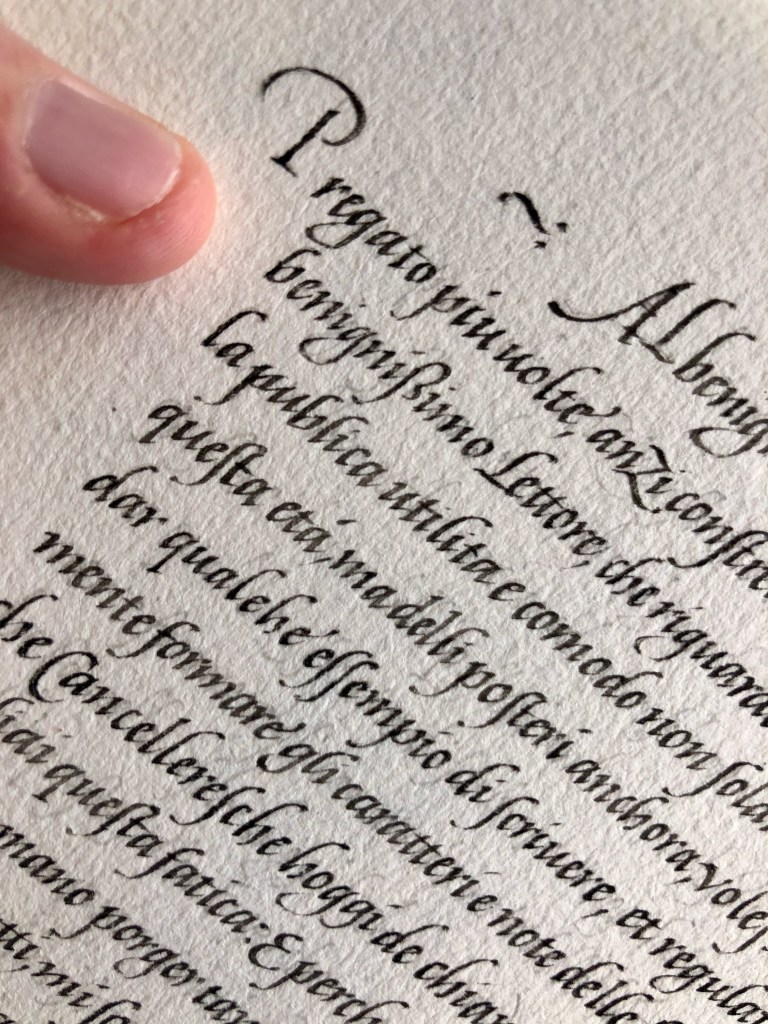
Beyond these cognitive benefits, the form the handwriting takes matters just as much. Letters are movement patterns as well as functional signs. There seems to be a widespread misunderstanding that the form of the letters is irrelevant, or at best of little importance, as long as students write by hand. We wouldn’t say the same about music — that it’s of little importance what the music sounds like as long as people play. Writing isn’t only for ourselves, either; we write as a means of communicating with others, which is why the alphabet is in essence normative. Letters are recognizable, and the clearest model is one whose letters are both joined and related in form — as in italic, rather than either disconnected print script or the looped copperplate hand.
If the only criterion for a handwriting model is that letters should be recognizable, so-called print script — where letters are separate entities, not connected by joins or loops — would seem to qualify. It looks similar to our printed letters, and many younger people who aren’t used to writing by hand default to it, sometimes even struggling to recognize letters that are joined. There is, however, a problem with this: it takes longer, which makes note-taking impractical. And when one tries to write an unconnected script quickly, it breaks down and loses legibility. So the one thing print script had going for it disappears the moment writing speeds up.
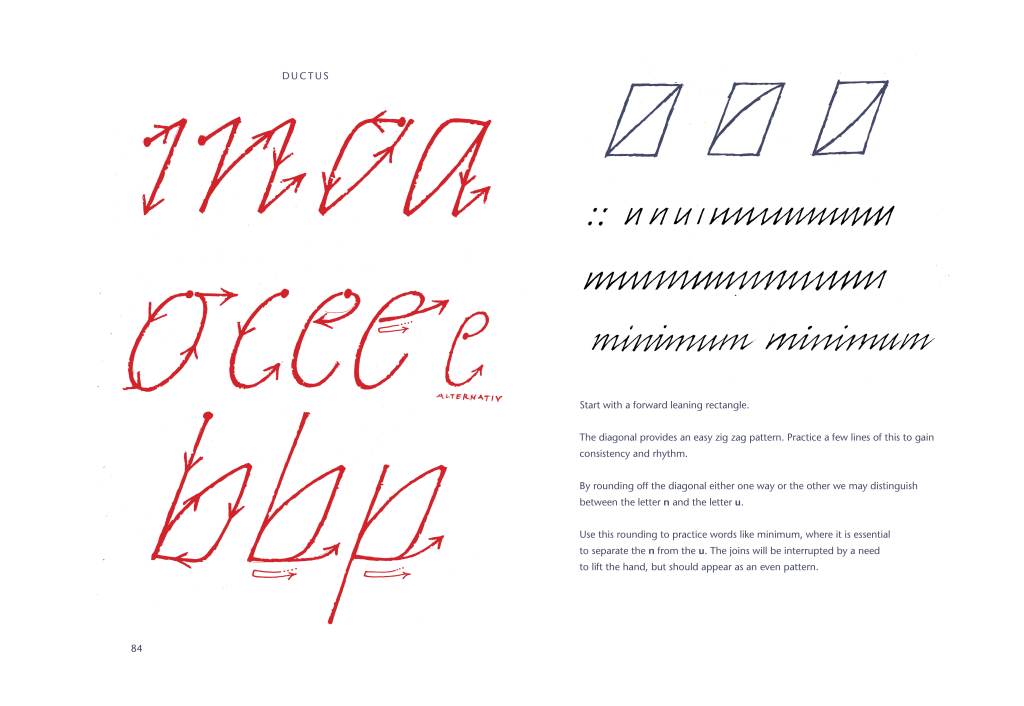
A joined model is therefore preferable — joins facilitate writing. But there’s a second factor, obvious to most calligraphers though less known to the public: family likeness, the principle of related forms within a given alphabet. When letters share many corresponding stroke movements, writing is simplified further still. A model that is both joined and built from related letterforms is the strongest combination.
The question of how handwriting should be joined — by loops or by ligatures — has long stalled the discussion of which normative model to choose, leaving two models to co-exist amid a good deal of confusion. Looped script, sometimes called ‘copperplate’ in English (its historical predecessor was often engraved onto copper plates), can look as though it were written without lifting the pen. In practice, a looped script requires lifting both hand and pen several times per line, and it is no quicker to write than a script joined with ligatures, like italic.
Italic dates back to the Renaissance and has proved effective in a modern world where pens range from pencils to ballpoints to thick markers. Its lack of loops gives letters clarity and increases legibility, without excluding the occasional loop or personal quirk.
A normative handwriting model matters because it improves form recognition and helps us evaluate letters, choose typefaces, and read longer passages of text with more ease — and it has the obvious advantage of giving others a chance to understand what we write. The way we write matters; the movement pattern needs to be functional, easy to write and easy to read.
This doesn’t mean learning to write can’t be strenuous, difficult, and time-consuming. A lot of learning is. But the advantages of being able to read and write largely outweigh these difficulties. If we are to stay civilized, letters are key.
[Oslo, 01.09.2026. Christopher Haanes]
References
Marano, G., Kotzalidis, G. D., Lisci, F. M., et al. (2025). The Neuroscience Behind Writing: Handwriting vs. Typing—Who Wins the Battle? Life, 15(3), 345. https://doi.org/10.3390/life15030345 ↩ ↩2 ↩3
Bara, F., & Bonneton-Botté, N. (2017). Learning Letters With the Whole Body: Visuomotor Versus Visual Teaching in Kindergarten. Perceptual and Motor Skills, 125(1), 190–207. https://doi.org/10.1177/0031512517742284 ↩ ↩2
Smoker, T. J., Murphy, C. E., & Rockwell, A. K. (2009). Comparing Memory for Handwriting versus Typing. Proceedings of the Human Factors and Ergonomics Society Annual Meeting, 53(22), 1744–1747. https://doi.org/10.1177/154193120905302218 ↩
van der Weel, F. R., & van der Meer, A. L. H. (2024). Handwriting but not typewriting leads to widespread brain connectivity: a high-density EEG study with implications for the classroom. Frontiers in Psychology, 14, 1219945. https://doi.org/10.3389/fpsyg.2023.1219945 ↩
Zhang, J., Kang, L.-Y., Li, J., et al. (2022). Brain Correlates of Chinese Handwriting and Their Relation to Reading Development in Children: An fMRI Study. Brain Sciences, 12(12), 1724. https://doi.org/10.3390/brainsci12121724 ↩
Bara, F., & Gentaz, É. (2011). Haptics in teaching handwriting: The role of perceptual and visuo-motor skills. Human Movement Science, 30(4), 745–759. https://doi.org/10.1016/j.humov.2010.05.015 ↩
